Introduction: Can Anyone Learn Piano?
Can anyone learn piano, even as a complete beginner? The honest answer is yes—and not just in theory. Every year, thousands of beginners learn to play the piano step by step without any prior musical background, natural “talent,” or childhood training. If you’ve ever believed that the piano is only for gifted kids or people who started young, this guide is here to break that myth for good.
The piano is one of the most beginner-friendly instruments in the world. Unlike many instruments where sound production itself is difficult, the piano produces a clear note the moment you press a key. This makes it incredibly approachable for beginners. You don’t need to worry about tuning, breath control, or complex hand positions on day one. You simply sit down, place your fingers correctly, and start playing. That simplicity is exactly why so many adults successfully learn piano later in life.
Another common misconception is that you need years of music theory before you can enjoy playing. In reality, beginners can start with simple melodies and patterns from the very first week. When piano learning is approached in the right order, progress feels motivating instead of overwhelming. That’s what this guide focuses on—clarity, structure, and practical learning.
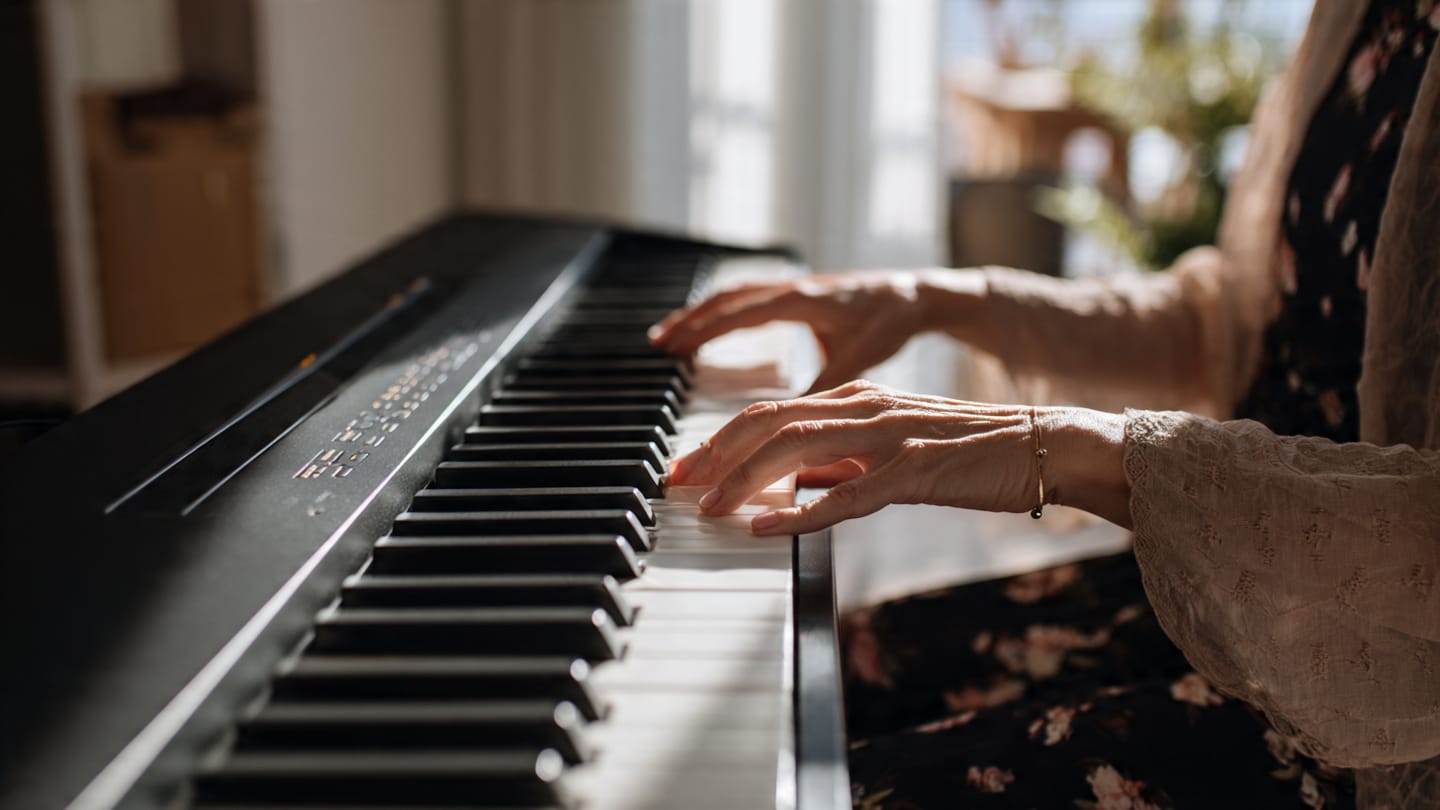
What This Guide Will Help You Achieve
This complete beginner’s guide is designed to take you from zero knowledge to confident playing:
- In 30 days, you’ll understand the keyboard layout, finger numbers, basic rhythms, and play simple melodies.
- In 60 days, you’ll start using both hands together, play basic chords, and perform easy songs smoothly.
- In 90 days, you’ll feel comfortable practicing on your own, play full beginner-level songs, and build a strong foundation for long-term progress.
Who This Guide Is For
This guide is perfect if you are:
- An absolute beginner with no music background
- An adult learner who thinks it might be “too late.”
- A self-learner who wants to learn piano at home without confusion
- Someone who wants a clear, step-by-step path instead of random lessons
If you’ve ever wanted to learn piano but didn’t know where to start, you’re in the right place.
Table of Contents
What You Need to Learn Piano (No Confusion)
One of the biggest reasons beginners delay learning piano is confusion about equipment. Piano, keyboard, number of keys, touch response—everything starts to feel overwhelming before you even play your first note. Let’s simplify this completely. You do not need expensive gear or a full acoustic piano to begin. You just need the right basics.
🎹 Piano vs Keyboard: Which Is Better for Beginners?
For most beginners, especially those learning at home, a keyboard is the smarter starting choice. An acoustic piano is large, expensive, and requires maintenance. A keyboard, on the other hand, is affordable, portable, and perfect for structured learning.
What matters is not whether it’s called a piano or a keyboard—but whether it allows you to build correct finger strength and control. With the right keyboard, you can learn piano techniques properly and later transition to an acoustic piano without difficulty.
🎼 Minimum Keys Required (49 vs 61 vs 88)
Beginners often think more keys automatically mean better learning. That’s not true.
- 49 keys: Too limiting. You’ll outgrow this quickly.
- 61 keys: Ideal for beginners. Enough range for exercises, songs, and two-hand playing.
- 88 keys: Full piano size. Excellent, but not mandatory when starting.
If space or budget is limited, 61 keys is the sweet spot for beginners.
🎚️ Touch Sensitivity (Explained Simply)
Touch sensitivity means the keyboard responds to how hard or soft you press the keys. This is extremely important.
Without touch sensitivity:
- Every note sounds the same
- You can’t control dynamics
- Expressive playing becomes difficult later
👉 Always choose a keyboard with touch-sensitive keys.
Weighted keys are a bonus, not a requirement at the start.
🎧 Accessories Beginners Actually Need
You don’t need fancy add-ons. Just these essentials:
- Keyboard stand – correct height prevents bad posture
- Bench or chair – sit at proper playing level
- Headphones – practice anytime without disturbance
- Sustain pedal (optional) – useful after the basics
✅ Beginner Decision Table (Quick Guide)
| Requirement | Best Choice for Beginners |
|---|---|
| Instrument | Keyboard (over acoustic piano) |
| Keys | 61 keys (minimum recommended) |
| Touch Sensitivity | Yes (mandatory) |
| Weighted Keys | Optional |
| Accessories | Stand + Bench + Headphones |
With these basics in place, you can confidently move forward and learn piano step by step—without wasting money or getting stuck in confusion.
📚 Suggested Beginner Piano Books
If you prefer learning piano with a clear, distraction-free structure, these beginner-friendly books complement the step-by-step approach explained in this guide.
The Ultimate Piano Book for Beginners
A practical introduction for absolute beginners, focusing on finger control, simple melodies, and consistent daily practice.
View on Amazon →Learn to Play Piano in 30 Days
A structured 30-day learning roadmap designed for adults and self-learners who want steady progress without overwhelm.
View on Amazon →Easy Hindi & Popular Songs for Piano
Beginner-friendly song arrangements that help learners stay motivated while improving rhythm, coordination, and confidence.
View on Amazon →How to Learn Piano from Scratch: The Correct Order
Most people who try to learn piano don’t quit because the instrument is hard—they quit because they follow the wrong learning order. Jumping between random YouTube videos, copying advanced songs too early, or skipping fundamentals creates confusion, frustration, and eventually burnout. Progress feels slow not because you lack ability, but because the foundation is missing.
This is the most important principle to understand:
👉 Piano must be learned in sequence, not in shortcuts.
Why Most Beginners Fail
The internet gives unlimited access to piano lessons, but unlimited choice often leads to zero structure. Beginners commonly:
- Watch random tutorials without continuity
- Learn songs without understanding finger placement
- Try both hands too early
- Chase speed instead of accuracy
This creates bad habits that later take more time to unlearn than to learn correctly in the first place.
The Correct Learning Sequence (Step by Step)
If you want to learn piano from scratch and actually progress, follow this order strictly.
1️⃣ Keyboard Layout Comes First
Before playing songs, you must understand:
- White keys vs black keys
- The repeating pattern of notes
- How to locate Middle C
This step builds spatial awareness. Without it, your hands will feel lost on the keyboard, slowing everything that comes later.
2️⃣ Finger Numbers (Non-Negotiable)
Each finger has a number (1–5).
This isn’t theory—it’s muscle training.
Learning finger numbers:
- Builds coordination
- Prevents awkward hand movement
- Makes reading exercises easier
Skipping this step leads to tension, slow playing, and frequent mistakes.
3️⃣ Right Hand First (Always)
Beginners should always start with the right hand.
Why?
- Right-hand handles melody
- Easier rhythm control
- Faster confidence boost
At this stage, focus on:
- Single-note melodies
- Simple finger patterns
- Smooth transitions
This builds control without mental overload.
4️⃣ Left Hand Comes Later (Support Role)
The left hand is introduced after right-hand comfort.
Here, you’ll learn:
- Simple bass notes
- Basic chord shapes
- Steady rhythm patterns
Introducing the left hand too early overwhelms the brain and slows coordination.
5️⃣ Both Hands Together (Only After Independence)
This is where many beginners fail.
Both hands should come together only when:
- Each hand works independently
- Finger movements feel natural
- Rhythm is stable
At this stage, progress feels slower—but this is where real piano playing begins.
Why Skipping Steps Slows Progress
Skipping steps may feel faster short-term, but it:
- Builds weak muscle memory
- Creates timing issues
- Increases mistakes
- Destroys confidence
Following the correct order may feel slower in the beginning, but it leads to faster, smoother progress long-term.
If you want to learn piano step by step and actually enjoy the journey, structure is not optional—it’s everything.
Piano Basics Every Beginner Must Learn First
Before playing songs or practicing exercises, every beginner needs to understand a few core piano basics. These fundamentals are simple, but they shape how easily—and how confidently—you’ll progress later. Skipping them leads to confusion and bad habits, so let’s keep this clear, practical, and beginner-friendly.
🎹 Names of Keys (White & Black Keys Made Easy)
The piano keyboard may look complicated at first, but it’s actually very logical.
- White keys are named: A B C D E F G
- These notes repeat in the same order across the keyboard
- Black keys come in groups of two and three
👉 The black keys don’t have to be memorized individually at the start. Instead, use them as landmarks to find white keys.
Example:
- C is always just before a group of two black keys
- F is always just before a group of three black keys
Once you see this pattern, the keyboard instantly feels familiar.
🎯 Middle C Explained (Your Starting Point)
Middle C is the most important reference point for beginners.
- It sits near the center of the keyboard
- It divides the keyboard into left (lower notes) and right (higher notes)
- Most beginner exercises and songs start from Middle C
Finding Middle C helps you:
- Position your hands correctly
- Understand pitch direction (left = lower, right = higher)
- Read simple music or number-based notes more easily
✋ Finger Numbering System (Critical for Control)
Each finger is assigned a number:
- Thumb = 1
- Index = 2
- Middle = 3
- Ring = 4
- Little finger = 5
This system applies to both hands.
Finger numbers are used in:
- Exercises
- Songs
- Practice routines
They train your hands to move efficiently. Ignoring finger numbers is one of the fastest ways to develop poor technique.
🪑 Basic Posture & Hand Position
Good posture prevents pain and improves control.
- Sit at a height where your elbows are slightly above the keys
- Keep your back straight but relaxed
- Shoulders loose, not raised
For hands:
- Fingers naturally curved
- Wrists relaxed, not stiff or dropped
- Imagine holding a small ball in each hand
Tension is the enemy of progress.
🥁 Reading Simple Rhythm (No Heavy Theory)
At the beginner stage, rhythm is about counting and consistency, not complex notation.
Start with:
- Counting aloud: 1-2-3-4
- Playing notes evenly
- Understanding long vs short notes by feel
You don’t need advanced theory—just steady timing and awareness.
Mastering these basics gives you a strong, confident foundation. Once these feel natural, learning piano step by step becomes smoother, faster, and far more enjoyable.
Learn Piano Step by Step (Beginner Roadmap)
One of the biggest questions beginners ask is: “What should I practice, and when?”
Without a roadmap, piano learning feels random. With a roadmap, it feels predictable, motivating, and achievable. Below is a clear step-by-step timeline that shows exactly how beginners should progress when learning piano from scratch.
This isn’t about rushing. It’s about learning in the right order, at the right pace.
🗓️ First 7 Days: Building the Foundation
The first week is about familiarity, not perfection. Your goal is to get comfortable with the keyboard and your fingers.
What to Focus On:
1️⃣ Finger Exercises
- Simple 5-finger patterns
- One hand at a time
- Slow and controlled movement
- Focus on accuracy, not speed
These exercises build finger strength and coordination, which makes everything easier later.
2️⃣ Right-Hand Melodies
- Single-note melodies using 3–5 fingers
- Songs that stay around Middle C
- No left hand yet
The right hand controls melody, so starting here boosts confidence quickly.
3️⃣ Simple Note Patterns
- Moving up and down the keyboard
- Repeating patterns
- Recognizing note positions by feel
What Progress Looks Like After 7 Days:
- You know your finger numbers
- You can find notes without hesitation
- Your hand movements feel more natural
- Playing no longer feels intimidating
🗓️ 30 Days: Coordination & Control
After one month, beginners move from “pressing keys” to actual music-making.
What to Focus On:
1️⃣ Both Hands (Introduced Carefully)
- Right hand continues melodies
- Left hand adds single bass notes
- Hands are practiced separately first, then together
This stage trains your brain to coordinate two hands without overload.
2️⃣ Basic Chords
- Simple major and minor chords
- Left-hand chord shapes
- Understanding how chords support melodies
Chords are the foundation of most songs, especially modern and popular music.
3️⃣ Simple Songs
- Easy beginner songs
- Slow tempo
- Focus on smooth transitions, not speed
What Progress Looks Like After 30 Days:
- You can play short songs
- Both hands work together (slowly but correctly)
- Chords feel familiar, not scary
- You can practice independently
At this point, most beginners realize: “Yes, I can actually learn piano.”
🗓️ 90 Days: Confidence & Musical Flow
By the third month, piano stops feeling mechanical and starts feeling musical.
What to Focus On:
1️⃣ Chord Progressions
- Common progressions used in songs
- Smooth chord changes
- Left-hand rhythm patterns
This unlocks the ability to play multiple songs with similar structures.
2️⃣ Playing Full Songs
- Complete beginner-level songs
- Intro, verse, and ending
- Maintaining flow without stopping
Mistakes still happen—but you recover smoothly.
3️⃣ Rhythm Confidence
- Steady timing
- Playing with a metronome (optional)
- Feeling the beat instead of counting every note
What Progress Looks Like After 90 Days:
- You can play full songs from start to finish
- Your hands feel independent
- Rhythm feels natural
- You enjoy practice instead of forcing it
Why This Step-by-Step Roadmap Works
Most beginners fail because they jump ahead. This roadmap works because:
- Each stage prepares you for the next
- Skills are layered, not rushed
- Confidence builds naturally
If you follow this learn piano step by step approach, progress becomes predictable—and that’s what keeps beginners consistent.
This roadmap doesn’t just teach you piano.
It teaches you how to learn piano the right way.
Learn Piano at Home Without a Teacher
One of the most common questions beginners ask is: Can you self-learn piano at home without a teacher?
The answer is yes—many beginners successfully learn piano on their own. However, the key difference between those who progress and those who quit is structure. Piano is not hard, but unstructured learning makes it feel hard.
When you follow a clear step-by-step path, self-learning becomes not only possible, but effective.
Can You Really Self-Learn Piano?
Yes—but not by randomly jumping between lessons.
Self-learners succeed when they:
- Follow a fixed learning order
- Practice consistently (even short sessions)
- Focus on fundamentals before songs
Without structure, beginners often confuse activity with progress—playing many things without mastering any of them.
Common Mistakes Self-Learners Make
Avoiding these mistakes can save you months of frustration:
- Watching random videos without continuity
- Playing songs too early without finger control
- Ignoring finger numbers and posture
- Practicing too fast instead of accurately
- Changing learning resources constantly
These habits create shaky foundations that slow long-term progress.
How to Practice Correctly Without Feedback
Not having a teacher doesn’t mean practicing blindly.
Here’s how to practice smart:
- Practice slowly and focus on accuracy
- Repeat short sections instead of entire songs
- Count out loud to maintain rhythm
- Record yourself and listen for mistakes
- Use a mirror or camera to check posture and hand position
These techniques replace external feedback with self-awareness, which is a powerful skill for independent learners.
Using Apps, Videos, and Books (Without Dependency)
Learning tools are helpful—but only when used intentionally.
- Apps are great for motivation and daily practice tracking
- Videos help with visual understanding of hand movement
- Books provide structured progression and reference material
The mistake is becoming dependent on tools instead of learning principles. Use them as guides, not crutches.
A well-structured beginner book or practice guide can be especially useful because it removes guesswork and keeps learning organized—something most self-learners struggle with.
The Right Mindset for Home Learning
When learning piano at home:
- Progress may feel slow at times—and that’s normal
- Consistency matters more than long practice hours
- Small daily improvements add up faster than occasional long sessions
With the right structure, realistic expectations, and reliable resources, learning piano at home without a teacher is not only possible—it can be deeply rewarding and empowering.
The piano doesn’t require supervision.
It requires clarity, patience, and a plan.
Learn Piano as an Adult
One of the biggest myths in music is that learning piano is only for children. Many adults want to start but hold themselves back with thoughts like “I’m too old,” “my brain won’t learn,” or “I missed my chance.” The truth is simple and encouraging: it is not too late to learn piano—not even close.
Adults around the world successfully learn piano every day, often faster than they expect.
The “Adult Brain” Myth (Why It’s False)
It’s true that children learn differently—but different does not mean better.
Adults may take slightly longer to build finger coordination, but they have stronger cognitive skills, better focus, and clearer goals. Learning piano is not about speed; it’s about consistency and understanding. Adults are excellent at both when guided properly.
Your brain remains capable of learning new motor and musical skills well into later life. Piano learning stimulates memory, coordination, and concentration—making it one of the healthiest skills adults can pick up.
Advantages Adults Have Over Kids
Adults actually have several advantages:
- Better discipline and time awareness
- Clear motivation (you chose this, no one forced you)
- Analytical thinking, which helps understand patterns and chords
- Emotional connection to music, which improves expression
Children may learn faster early on, but adults often progress more steadily and with purpose.
Practice Time Reality (20–30 Minutes Is Enough)
You don’t need hours of practice.
For adult beginners:
- 20–30 minutes a day is ideal
- Short, focused sessions work better than long, tiring ones
- Consistency matters more than intensity
A well-structured daily routine can deliver real results even with limited time.
Motivation & Staying Consistent
The biggest challenge for adults isn’t ability—it’s consistency.
To stay motivated:
- Set small, realistic goals
- Track visible progress (songs learned, skills unlocked)
- Accept mistakes as part of learning
- Enjoy the process, not just the result
Learning piano as an adult is not about becoming perfect. It’s about progress, enjoyment, and personal fulfillment.
If you’ve ever wanted to learn piano, adulthood is not a barrier—it’s an advantage.
How Long Does It Take to Learn Piano?
One of the most honest questions beginners ask is: “How long does it take to learn piano?”
The real answer depends on how you define learning. Piano is not something you “finish”—it’s a skill you grow into. However, beginners can reach clear, meaningful milestones in a predictable timeline when they practice consistently and follow the right method.
Below is a realistic, honest breakdown of what most beginners can expect.
🎯 After 1 Month
In the first month, beginners are building the foundation.
You can expect to:
- Understand the keyboard layout and finger numbers
- Play simple right-hand melodies
- Read basic rhythms
- Practice independently without confusion
At this stage, songs are slow and simple—but progress feels exciting. You’re no longer guessing; you’re learning with intention.
🎯 After 3 Months
This is where piano starts to feel like real music.
Most beginners can:
- Play with both hands together (at a slow tempo)
- Use basic chords and bass notes
- Perform full beginner-level songs
- Maintain steady rhythm with fewer stops
Mistakes still happen, but confidence increases significantly. Many learners reach the point where they can sit down and play something recognizable.
🎯 After 6 Months
By six months, consistency pays off.
You may be able to:
- Play several songs from memory
- Change chords smoothly
- Keep rhythm without constant counting
- Learn new beginner songs much faster
You’re no longer “starting piano”—you’re playing piano.
🎯 After 1 Year
After one year of regular practice:
- You can play a variety of songs comfortably
- Both hands feel coordinated
- Rhythm and timing feel natural
- You’re ready to explore intermediate techniques
You won’t be a concert pianist—and that’s perfectly normal. What you will have is a strong, solid foundation that allows continuous improvement.
The Honest Truth
Learning piano is not about speed—it’s about direction and consistency.
With 20–30 minutes of focused daily practice, most beginners can achieve impressive progress within a year.
Slow progress done correctly always beats fast progress done wrong.
Daily Piano Practice Routine for Beginners
One of the biggest reasons beginners struggle is not lack of talent—but not knowing how to practice. A good daily piano practice routine removes guesswork and keeps progress consistent, even when time is limited. The key is balance: technique, music, and enjoyment must all coexist.
Below are simple, realistic routines you can follow based on the time you have.
⏱️ 20-Minute Practice Routine (Busy Days)
Perfect for adults with limited time.
🔸 Warm-up (3–4 minutes)
- Gentle finger stretches
- Slow 5-finger patterns (one hand at a time)
- Focus on relaxed hands
🔸 Technique (5–6 minutes)
- Finger exercises
- Simple scales or note patterns
- Play slowly and evenly
🔸 Song Practice (7–8 minutes)
- Work on a small section of one song
- Hands separately if needed
- Accuracy over speed
🔸 Fun Time (2–3 minutes)
- Play something you enjoy
- Improvise freely
- Repeat a favorite melody
⏱️ 30-Minute Practice Routine (Ideal Daily Routine)
This is the sweet spot for most beginners.
🔸 Warm-up (5 minutes)
- Finger exercises
- Hand coordination drills
🔸 Technique (8–10 minutes)
- Scales or chord patterns
- Focus on finger control and timing
🔸 Song Practice (10–12 minutes)
- Practice beginner songs
- Combine both hands gradually
- Work on smooth transitions
🔸 Fun Time (3–5 minutes)
- Play without pressure
- Try variations or familiar tunes
- Enjoy the sound you’re creating
⏱️ 45-Minute Practice Routine (High Focus Days)
Best when you have energy and time.
🔸 Warm-up (5–7 minutes)
- Slow exercises
- Posture and hand relaxation check
🔸 Technique (12–15 minutes)
- Scales, chords, arpeggio basics
- Focus on consistency and control
🔸 Song Practice (18–20 minutes)
- Full songs or challenging sections
- Hands together practice
- Work with rhythm and flow
🔸 Fun Time (5 minutes)
- Free playing
- Favorite songs
- Creativity without rules
Why “Fun Time” Matters
Fun time prevents burnout.
It reminds you why you wanted to learn piano in the first place.
Consistency beats intensity. A short, focused routine done daily will always outperform long, irregular practice sessions.
👉 Tip: Save these routines as a reference. A downloadable PDF version can make daily practice even easier.
Best Way to Learn Piano Faster (Without Burnout)
Every beginner wants to learn piano faster—but speed without strategy leads to frustration and burnout. Real progress comes from smart practice, not longer practice. The goal is to improve efficiently while keeping learning enjoyable and sustainable.
Here’s what actually works.
🐢 Slow Practice vs Fast Practice
The fastest way to learn piano is to practice slowly.
Slow practice:
- Builds correct muscle memory
- Improves accuracy and control
- Reduces mistakes
Fast practice, when done too early:
- Reinforces errors
- Creates tension
- Slows long-term progress
A simple rule:
👉 If you can’t play it slowly, you can’t play it fast.
Speed naturally develops once movements are clean and confident.
🔁 Smart Repetition Strategy
Repetition is essential—but mindless repetition is useless.
Effective repetition means:
- Repeating short sections (1–2 lines)
- Fixing mistakes immediately
- Pausing between repetitions to reset
Instead of playing a song from start to finish ten times, repeat the difficult part five times correctly. Quality beats quantity every time.
🎵 Song-Based Learning (Motivation Multiplier)
Beginners learn faster when they practice songs, not just exercises.
Songs:
- Improve coordination naturally
- Build rhythm and timing
- Keep motivation high
Exercises prepare your fingers, but songs train your brain. A balanced approach—technique plus songs—prevents boredom and accelerates progress.
🎧 Recording Yourself (Underrated Power Tool)
Recording your practice is one of the most effective self-learning tools.
It helps you:
- Hear mistakes you don’t notice while playing
- Track progress over time
- Improve rhythm and clarity
Even a simple phone recording can replace external feedback when learning at home.
⛔ When NOT to Practice
Knowing when to stop is just as important as knowing when to practice.
Avoid practicing when:
- You’re extremely tired
- Your hands feel tense or painful
- You’re mentally frustrated
Practicing in these states builds bad habits. A short break—or skipping a day—is better than reinforcing mistakes.
The Real Secret to Faster Learning
Learning piano faster isn’t about pushing harder.
It’s about practicing smarter, staying relaxed, and enjoying the process.
Burnout slows progress. Consistency accelerates it.
If you respect your limits and follow these principles, improvement becomes natural—and piano stays a joy, not a burden.
Beginner Piano Songs to Start With
Choosing the right songs at the beginning can make or break your piano journey. Beginner piano songs should build confidence, not frustration. The goal is not to impress—it’s to train your fingers, timing, and musical sense in a gradual, enjoyable way.
Here’s how beginners should approach songs when learning piano from scratch.
🎶 Start with Simple Melodies
In the early stages, songs should be:
- Slow and predictable
- Limited to a small range of keys
- Based on repeated note patterns
Simple melodies help you focus on:
- Finger movement
- Note recognition
- Smooth transitions
These songs may sound basic, but they are powerful teachers.
✋ Right-Hand-Only Songs First
Beginners should always start with right-hand-only songs.
Why this works:
- Reduces mental overload
- Builds melodic confidence
- Trains finger independence
Right-hand practice allows beginners to enjoy playing music before coordinating both hands. The left hand is introduced later as support, not pressure.
🎹 Popular & Bollywood-Friendly Approach
Many beginners stay motivated when they recognize the tune.
Instead of jumping into complex arrangements, start with:
- Simplified versions of popular melodies
- Familiar Bollywood themes reduced to basic notes
- Folk or film melodies adapted for beginners
The familiarity helps your brain predict the music, making learning faster and more enjoyable.

40 Easy Hindi Songs Piano Notes Book – Bollywood Songs for Beginners
🔢 Number-Based Learning (Beginner Friendly)
For learners who find traditional notation intimidating, number-based systems are a great starting point.
Number-based learning:
- Uses finger numbers or key positions
- Focuses on patterns instead of symbols
- Helps beginners start playing immediately
This method is especially useful for self-learners and those who want to play songs quickly without heavy theory.
How to Use Songs Correctly
Songs are tools, not shortcuts.
- Practice slowly
- Break songs into small sections
- Focus on smooth flow, not speed
Once a song feels comfortable, move on to the next slightly harder one.
The right beginner songs don’t just teach music—they build confidence, consistency, and a genuine love for the piano.
Common Beginner Mistakes (Save Years)
Most beginners don’t fail at piano because they lack ability—they fail because they repeat the same avoidable mistakes. Understanding these early can literally save you years of frustration and stalled progress. If you’re learning piano from scratch, pay close attention to these.
🚫 Playing Too Fast
This is the most common mistake.
Beginners often equate speed with skill, but fast playing without control:
- Reinforces wrong notes
- Destroys rhythm
- Builds sloppy muscle memory
Slow, accurate practice always leads to faster progress later. Speed comes naturally when movements are clean.
🚫 Skipping Finger Numbers
Finger numbers exist for a reason.
Ignoring them:
- Causes awkward hand movement
- Slows coordination
- Creates tension and fatigue
Correct fingering makes difficult passages feel easy. Skipping it makes easy passages feel difficult.
🚫 Ignoring the Left Hand
Many beginners avoid the left hand because it feels harder.
This creates:
- One-sided development
- Weak rhythm support
- Difficulty when both hands are required
The left hand doesn’t need to be perfect—but it must be trained gradually.
🚫 Chasing Advanced Songs Too Early
Trying to play advanced songs too soon leads to:
- Frustration
- Poor technique
- Loss of confidence
Advanced songs require foundations that beginners don’t yet have. Learning easier songs well is what prepares you for harder ones later.
🚫 Inconsistent Practice
Practicing once a week for two hours is far worse than:
- 20 minutes daily
Inconsistency resets progress and breaks muscle memory. Piano rewards routine, not intensity.
The Simple Fix
Avoid these mistakes, and the piano becomes far easier than most people think.
Progress isn’t about talent—it’s about patience, structure, and smart habits.
Learn slowly, practice consistently, and let your skills build naturally.
Frequently Asked Questions (FAQs)
Can I learn piano without reading music?
Yes, you can learn piano without reading traditional music notation—especially at the beginner stage. Many beginners start by learning note positions, finger numbers, and patterns instead of sheet music. This approach allows you to play simple songs quickly and build confidence. Over time, learning basic notation becomes easier and more meaningful once you understand how the keyboard works. Reading music is a helpful skill, but it is not a requirement to start learning piano.
Is a keyboard okay instead of a piano?
Absolutely. A keyboard is perfectly fine for beginners. In fact, most beginners learn piano on a keyboard at home. The key requirement is that the keyboard has touch-sensitive keys so you can control volume and dynamics. A 61-key keyboard is more than enough to learn fundamentals, play songs, and develop proper technique before transitioning to an acoustic piano if you choose
How much should beginners practice piano?
For beginners, 20–30 minutes a day is ideal. Short, focused daily practice is far more effective than long, irregular sessions. Consistent practice helps build muscle memory, coordination, and confidence. On busy days, even 15–20 minutes is enough to maintain progress.
Is piano hard for adults?
No. Piano is not hard for adults—it’s just different from how children learn. Adults may take a little longer to build finger coordination, but they understand patterns, instructions, and structure better. With a clear step-by-step approach, adults often progress steadily and enjoy the learning process more because it’s a personal choice, not a forced activity.
Can I learn piano online?
Yes, you can learn piano online successfully. Many beginners learn at home using videos, apps, and structured practice materials. The key is following a clear learning path instead of jumping between random lessons. With consistency and the right resources, online piano learning can be just as effective as in-person lessons for beginners.
Conclusion & Next Steps
Learning piano is not about talent, age, or background—it’s about starting correctly and staying consistent. If you’ve read this guide, you already have something most beginners don’t: clarity. You now know what to learn, in what order, and how to practice without confusion or burnout.
Remember, every confident pianist you admire once sat at the keyboard as a beginner, pressing keys slowly and making mistakes. Progress doesn’t come from perfection—it comes from showing up regularly and following a simple plan.
🎹 Your Next Steps (Do This Now)
1️⃣ Start Day 1 Today
Don’t wait for the “perfect” moment. Sit at the keyboard today—even for 10 minutes—and begin with basic finger exercises or a simple right-hand melody.
2️⃣ Follow the Step-by-Step Roadmap
Avoid jumping ahead. Use the beginner roadmap outlined in this guide and trust the process. Each stage builds the foundation for the next.
3️⃣ Practice Consistently, Not Perfectly
Short daily practice beats long, irregular sessions. Stay patient and focus on steady improvement.
4️⃣ Explore Related Beginner Guides
To continue learning, move next to:
- Learn piano at home without a teacher
- Daily piano practice routine for beginners
- Beginner piano songs to start with
Final Encouragement
Piano learning is not a race. It’s a skill you grow into—slowly, confidently, and enjoyably. If you stay consistent and follow the structure, the results will come.
The only real mistake is not starting.
Sit down, place your fingers on the keys, and begin. 🎹
Thanks for choosing Saptak.Shop for your Piano Learning guides